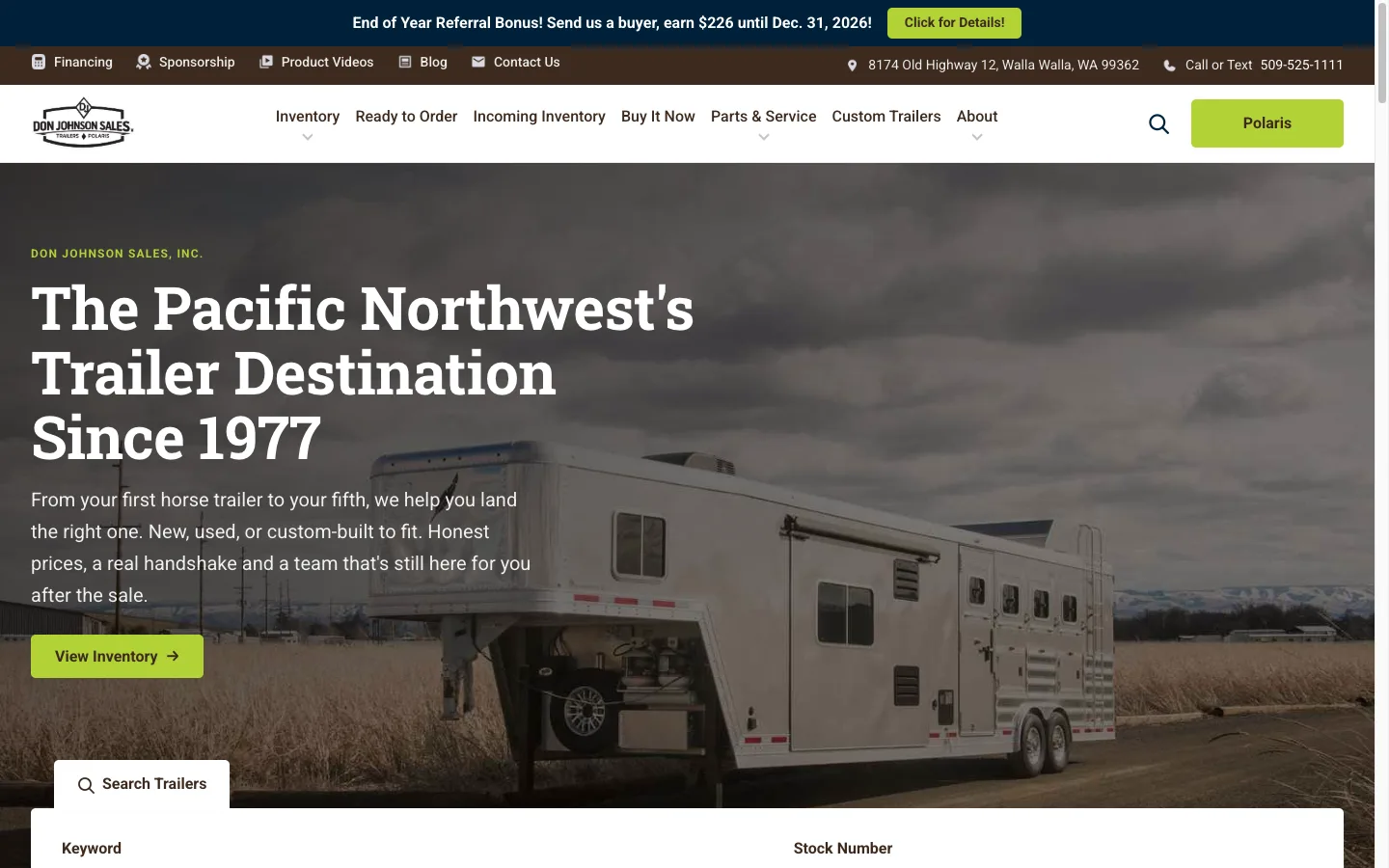
How Ariel Digital replaced a template dealer platform with a custom WordPress theme for The Trailer Place: searchable inventory, trailer compare and local SEO.
Location: Walla Walla, Washington · Industry: Trailer and RV dealership · Platform: Custom WordPress theme (no page builder, no parent theme) · Live site: thetrailerplace.com
At a Glance
- 232 trailers in a fully searchable, filterable inventory the dealership’s staff manage themselves
- One custom WordPress theme replacing a template dealer platform, with no page builder and no third-party theme
- 23 custom content blocks so staff can build and edit pages in the WordPress editor without touching code
- Side-by-side trailer comparison for up to three units at once
- 148 legacy URLs from earlier versions of the site 301-redirected to their new homes so search rankings carried over
- AutoDealer structured data, a clean XML sitemap for every inventory type, and keyword-focused page titles on every template
- Launched September 17, 2026, then supported with ongoing feature rounds through the fall
The Client
Don Johnson Sales has sold trailers out of Walla Walla, Washington since 1977. As The Trailer Place, the family-run dealership is one of the largest trailer dealers in the Pacific Northwest. It carries horse trailers, living-quarters trailers, livestock, utility, cargo, dump and flatbed trailers, truck beds, and Polaris equipment from brands including Trails West, Featherlite, C&B, Aluma and Air-Tow.
Their buyers are ranchers, horse owners, contractors and outdoor families. Many shop on a phone from a truck cab or a barn, and they compare dealers before they ever pick up the phone.
The Challenge: A Template Dealer Site That Looked Like Everyone Else’s
The Trailer Place had moved to Dealer Spike, a hosted dealer platform, after an earlier custom WordPress site was retired. The platform kept inventory online, but the dealership had almost no control over it.
In our discovery call, their team put it plainly:
“It’s incredibly cookie cutter. We have almost no control over what we can do.”
The specific problems were:
- No identity. The site used the same layout as hundreds of other dealers, with a different logo on top. Nothing told a buyer this was a third-generation family business.
- Weak inventory search. Buyers got one generic search bar with no real filtering by category, brand, pull type, horse stalls or living quarters.
- No field-level control. Staff couldn’t add the details that set one trailer apart from another, so listings looked thin.
- A mobile experience that was just okay, for an audience that shops mostly on phones.
- SEO equity at risk. Years of indexed inventory and page URLs, from both the Dealer Spike site and the older WordPress site, would break in any rebuild unless they were carefully mapped.
The goal was a site that felt as straight-talking as the people on the lot, gave staff full control of their inventory, and got a buyer from “I need a trailer” to a specific unit and an inquiry as fast as possible.
Our Approach
1. Discovery and site architecture
We began with a scoping session and a full review of the dealership’s earlier sites, including the 2019 version they liked. From there we built a sitemap, a field-by-field model of what a trailer listing needs, and a locked design system: navy, lime, blue and saddle-brown colors with Roboto Slab and Roboto type.
We made one key architecture decision early: no page builder. Page builders make a site slow and fragile and leave clients with layouts that break when edited. Instead, we built a standalone custom theme on WordPress, with Advanced Custom Fields (ACF) Pro powering both the inventory data and a library of editable content blocks.
2. A custom inventory system built for how dealers actually work
Inventory is the heart of a dealer website, so we built it as its own content type with taxonomies for category, brand, condition, pull type and status.
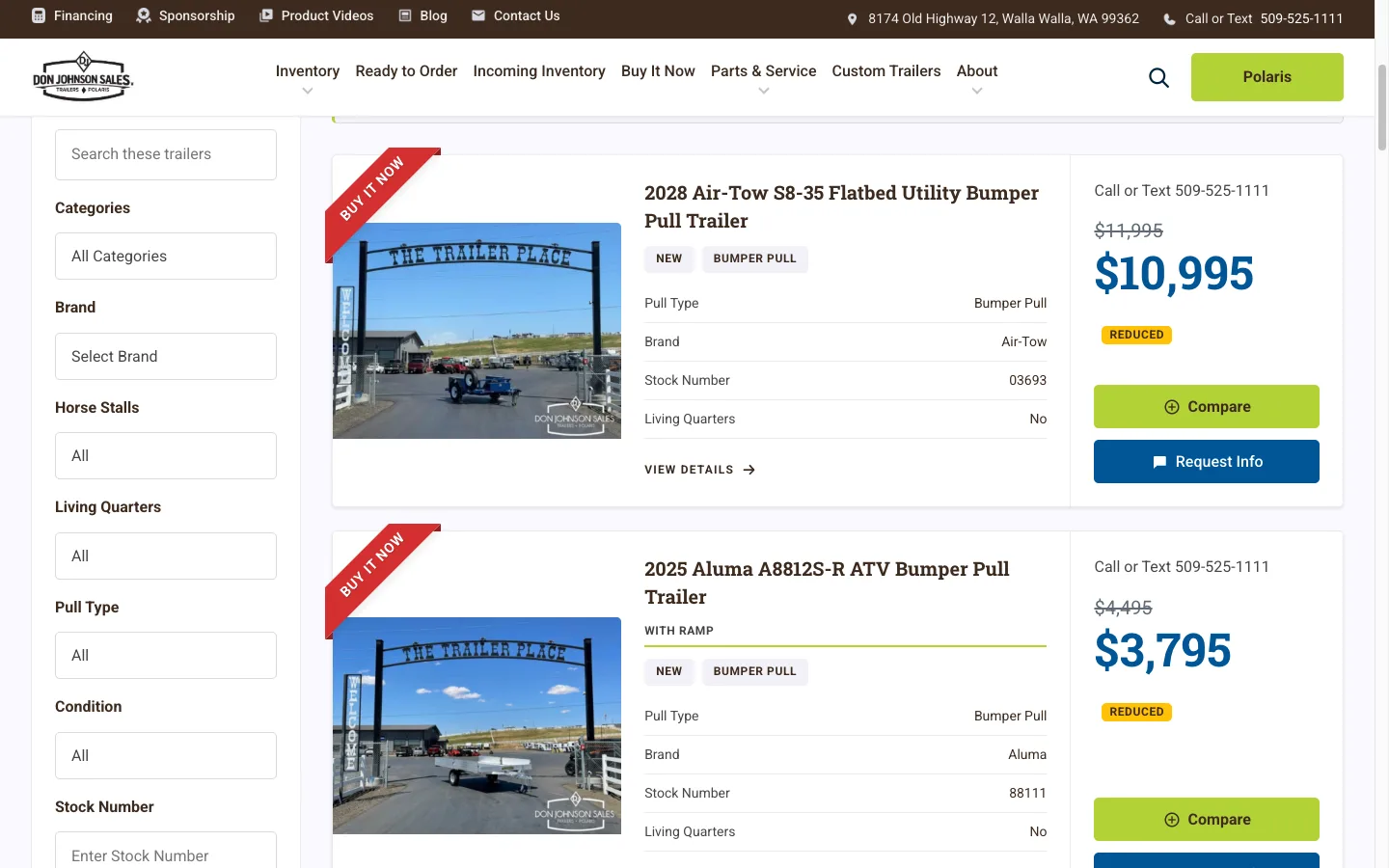 Inventory search filters by the details trailer buyers actually shop on.
- Filtering that matches how people shop. Buyers can narrow by category, brand, horse stalls, living quarters, pull type, condition, price and length, or jump straight to a stock number.
- Fast data entry. Staff type features as simple comma-separated lists, and the theme turns them into clean, formatted lists on the page. A save guard strips the invisible characters that sneak in from copy-and-paste, so no blank rows reach the site.
- Smart pricing display. A single pricing function handles sale prices, strike-through “was” prices, “Reduced” badges and “call for price” text the same way everywhere, from the listing card to the detail page to the compare table.
- Status-aware listings. Incoming, Ready to Order, Buy It Now and Clearance units each get their own page, badges and calls to action.
- Built for the back office. Sortable admin columns, a one-click Duplicate action for similar units, CSV export, and an XML/HTML export for the dealership’s syndication partner.
3. Trailer detail pages that answer the buyer’s questions
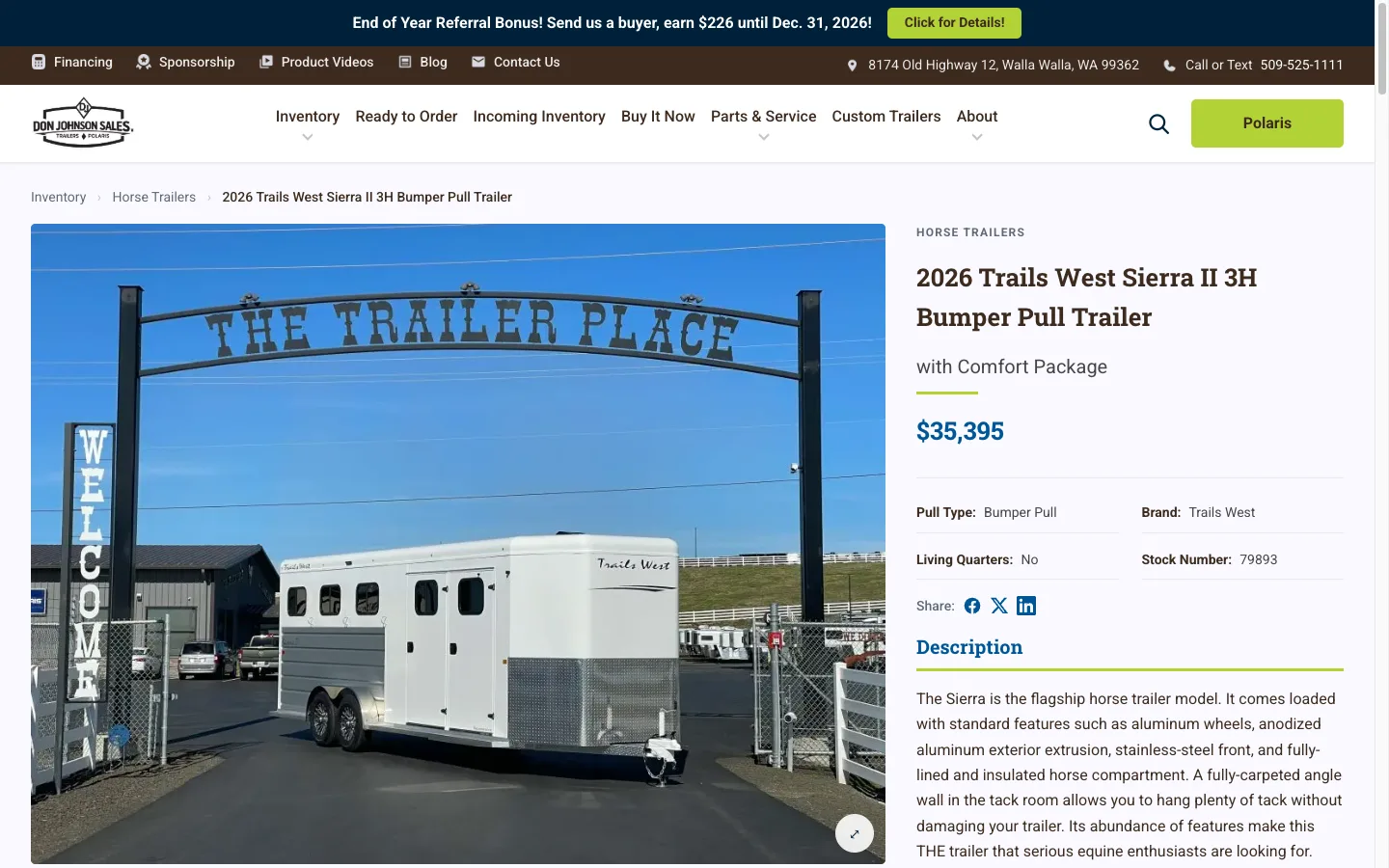 Every unit gets a full detail page with gallery, specs, documents and a request-info form.
Every trailer gets a full detail page with a photo gallery and lightbox, key specs up front, a full spec table, features, floor plans, MSRP sheets and brochures, and a request-info form tied to that unit. Units without photos still look professional, thanks to custom illustrated placeholder artwork for each trailer type.
4. Side-by-side trailer comparison
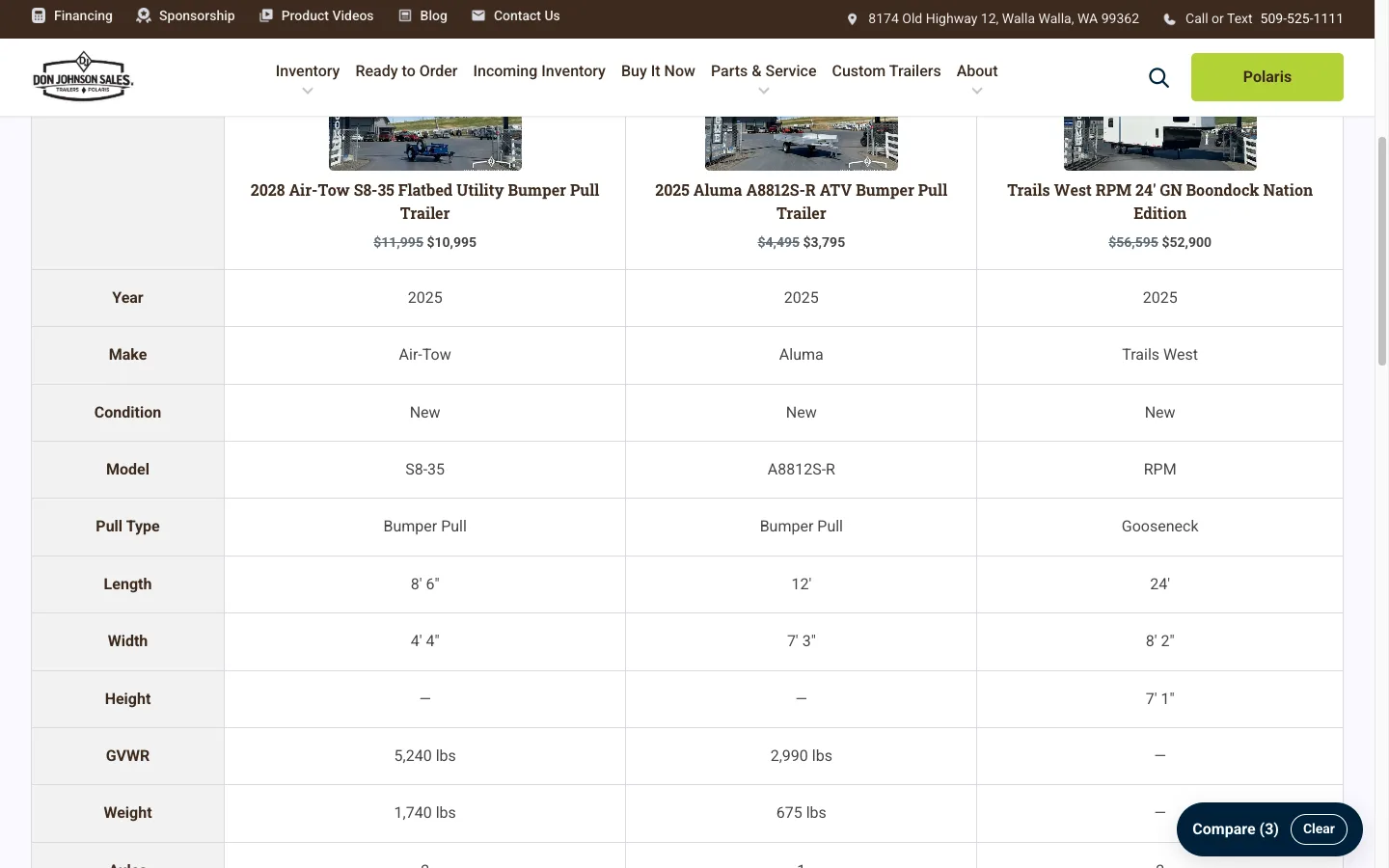 Up to three trailers compared spec by spec.
Buyers choosing between units can add up to three trailers to a compare tray from any listing and see them side by side, spec by spec. The detail page and the compare table share one spec builder, so the numbers always match.
5. Mobile-first, “truck-cab real” design
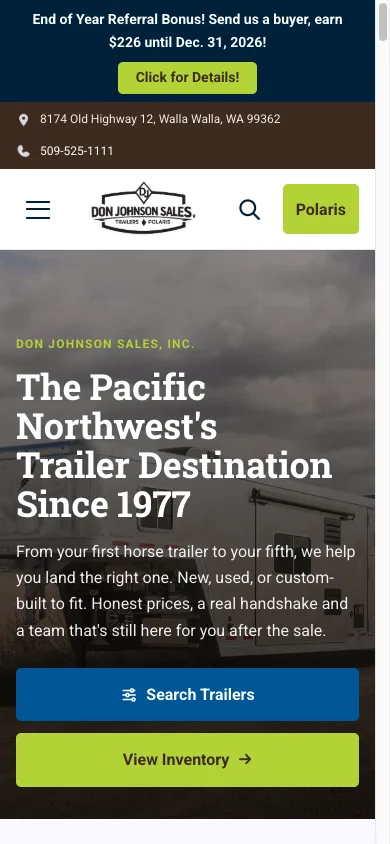
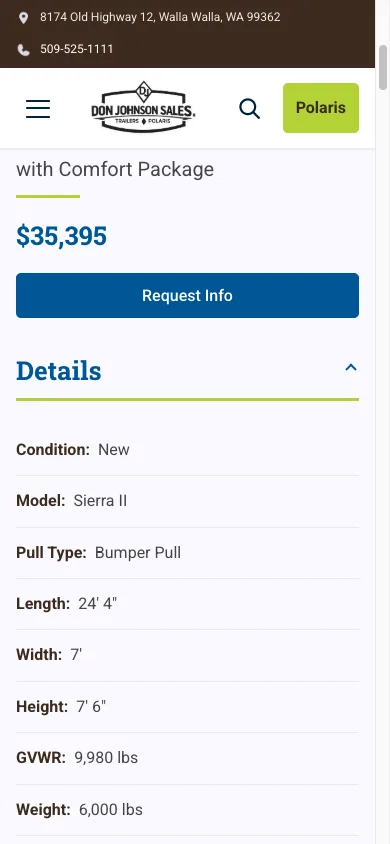
The homepage and a trailer’s specs on a phone, with the key actions under the thumb.
Base styles were written for phones first. On mobile, inventory filters move into a slide-out “Filter & sort” sheet, the homepage hero puts Search Trailers and View Inventory right under the thumb, touch targets are at least 44×44 pixels, and every template was checked for horizontal scroll. The build targets WCAG 2.1 AA accessibility, with keyboard-friendly menus, visible focus rings and support for reduced motion.
6. Pages the dealership can edit themselves
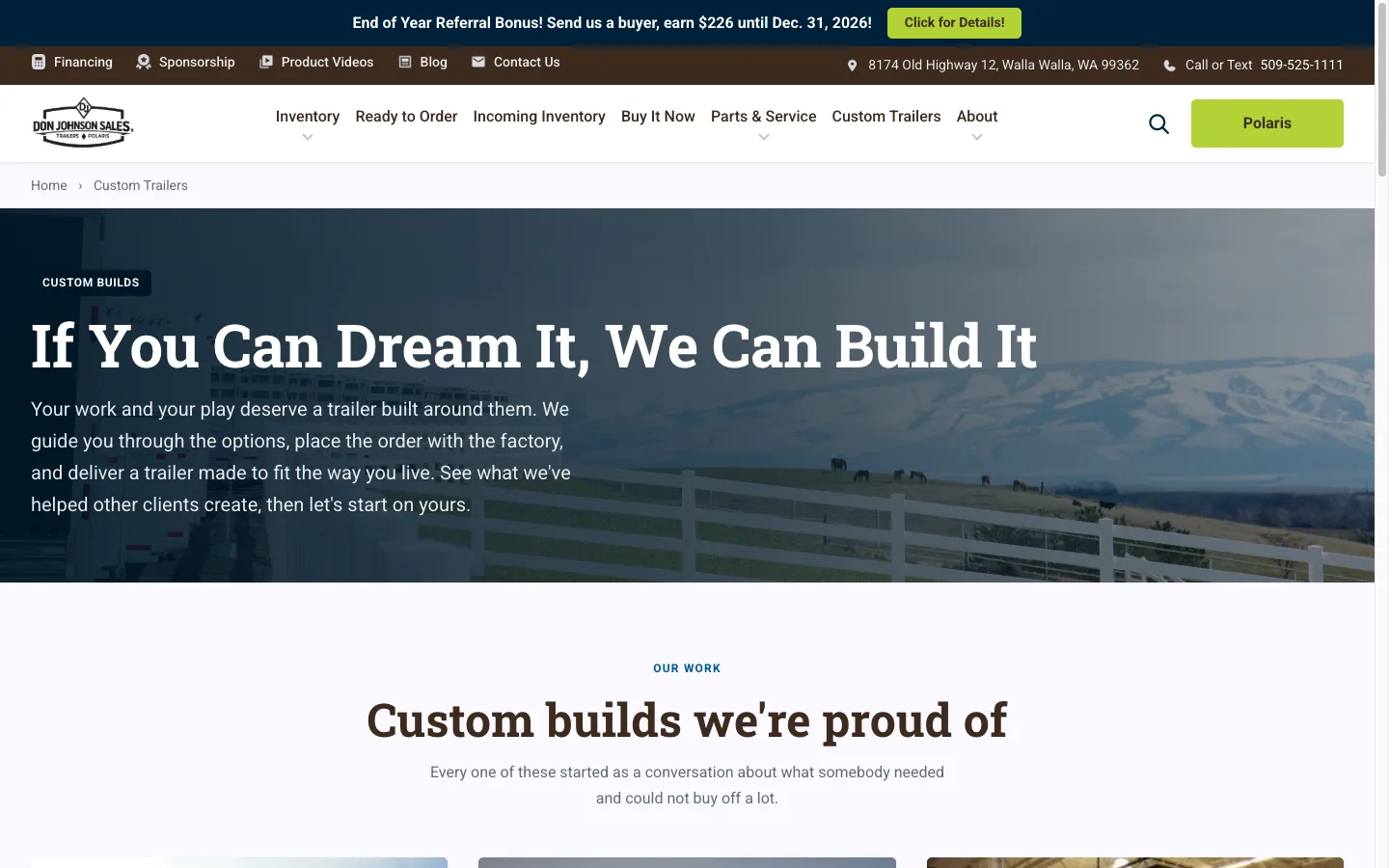 The Custom Trailers page, built by staff from the theme’s content blocks.
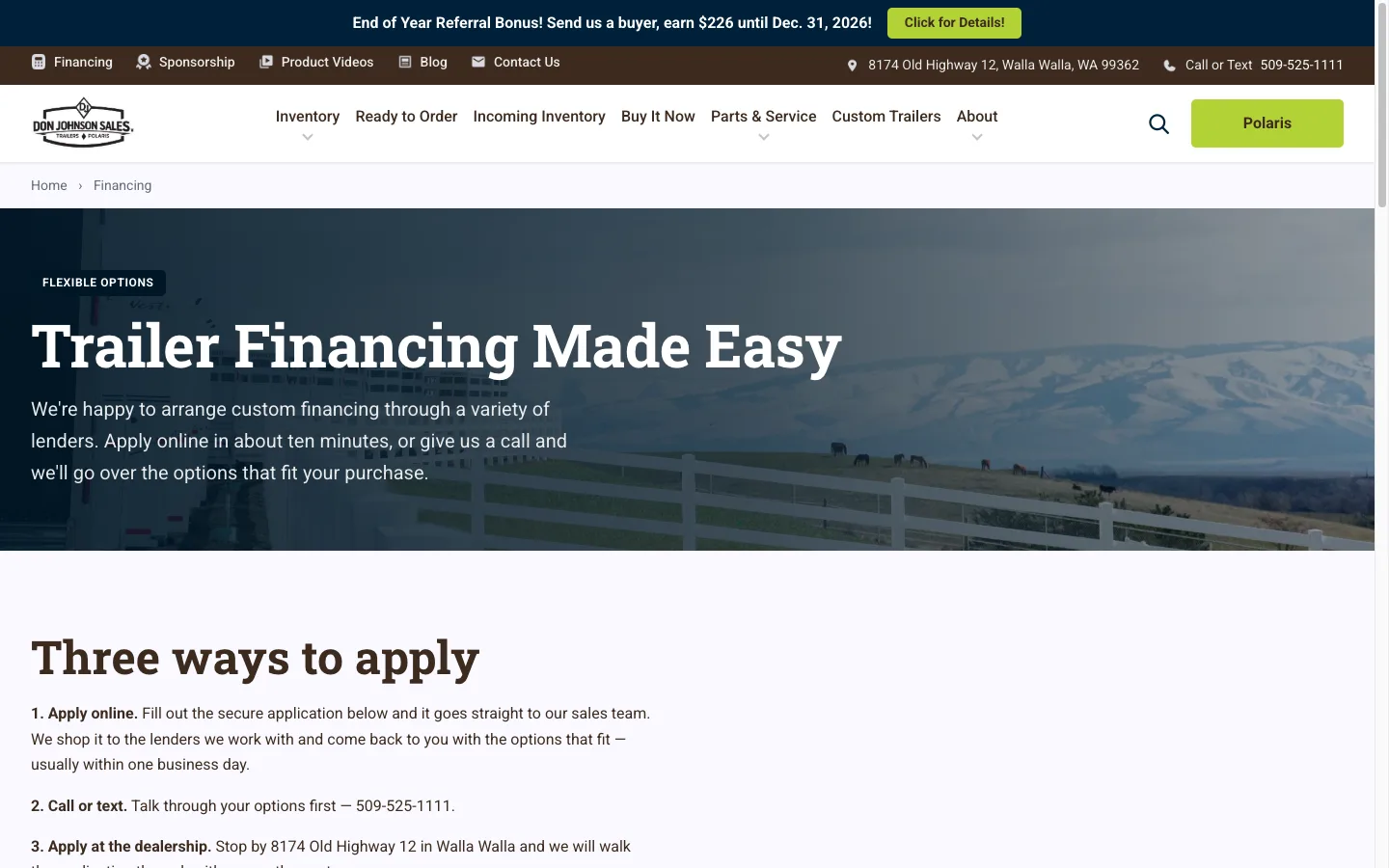
We built 23 custom ACF blocks, including page heroes, story and video sections, team grids, reviews, FAQs, financing bands, stat bands, service grids and a live inventory feed. The office team uses them in the normal WordPress editor to build pages like About, Financing, Custom Trailers, Sponsorship and Parts & Service. A block left empty prints nothing, so a half-filled section never shows up broken on the live site.
Other features the dealership manages on its own:
- A custom builds library showing past one-off trailers
- Product video playlists pulled automatically from their YouTube channel
- A site-wide notification bar for promotions, such as their year-end referral bonus
- A blog with categories and templates for news and buying guides
- Contact forms with topic-based routing, so each inquiry goes straight to the right person
- Search insights, an admin dashboard widget showing what visitors search for on the site
SEO: Protecting Rankings and Building Local Visibility
A redesign can wipe out years of search traffic. SEO was built into this project from day one, not added at the end.
Redirect mapping
We mapped 148 legacy URL patterns, from the old Dealer Spike inventory paths and the earlier WordPress site, to their new equivalents with permanent 301 redirects. We built them into the theme rather than a plugin and verified every one against the live server after launch, including paths Google was still crawling from versions of the site several years old.
Structured data for a local dealer
The site outputs AutoDealer (LocalBusiness) schema with the dealership’s address, phone, opening hours and contact point, plus WebSite and SearchAction markup. That ties the site to the dealership’s Google Business Profile for searches like “trailer dealer Walla Walla.”
On-page and technical SEO
- Keyword-focused titles on every template, such as “Trailers for Sale in Walla Walla, WA” for the homepage, year/make/model/stock number for each trailer, and “Trailer Financing | Apply Online in 10 Minutes” for the financing page
- Indexable taxonomy pages for every category, brand, condition and pull type, each with its own XML sitemap
- Breadcrumbs on inventory and content pages
- Clean, permanent inventory URLs (
/inventory/{stock-number}/) - An
llms.txtfile so AI search tools can understand the dealership and its inventory - Fast page loads: WebP images served automatically, minified scripts, Brotli compression and long-lived browser caching, all of which feed Core Web Vitals
Security, Hosting and Reliability
We handled the move to new managed hosting and set the site up for the long term:
- Cloudflare in front of the site for bot protection and caching, set up after a launch-week traffic flood aimed at an old URL
- Two-factor authentication required for all admin and editor accounts, with branded login screens
- Authenticated email delivery for every form (SPF, DKIM and DMARC all passing), with each form tested end to end
- Comment spam shut off site-wide, since the dealership doesn’t use comments
- A separate staging site for testing, plus scripted deployments and content syncs
- Re-runnable audit scripts that check inventory data, documents, upload permissions and more, so problems are caught before buyers see them
The Development Process
We built and maintained the theme with a disciplined, version-controlled workflow:
- Every change was built locally, tested on staging, then deployed to production
- About 400 commits from the first template build in June 2026 through launch and the support rounds that followed
- Automated verification suites for key features (pricing, comparison, site search, video playlists and more) that run before each deploy
- AI-assisted development with Claude Code, under senior developer review, so we could ship client feedback rounds in days instead of weeks
After launch we kept shipping. Fall 2026 rounds added a sortable admin inventory list, multiple floor plans per trailer, strike-through pricing, a CSV inventory export, a contact pop-up, an RV service plans page and contact-form routing updates, each one tested on staging before it went live.
Results
- Full ownership. The Trailer Place now owns its website, its code and its data instead of renting a template.
- Staff run the inventory. The office team adds, edits, prices and retires 200+ trailers without calling a developer.
- A brand that sounds like them. The site tells a third-generation family story with real staff photos, sponsorships and plain talk, instead of a stock dealer template.
- Search equity kept. Old URLs 301-redirect to their new pages, and the site now sends search engines richer local business data than it ever did before.
- A faster path to a sale. Search, filter, compare, request info, all in a few taps on a phone.
Technology Used
| Layer | Technology |
|---|---|
| CMS | WordPress (custom standalone theme) |
| Custom fields and blocks | Advanced Custom Fields Pro |
| Forms | Gravity Forms with conditional routing |
| SEO | Rank Math Pro, custom AutoDealer schema, theme-level 301 redirects |
| Security | Two-factor authentication, Cloudflare |
| WP Mail SMTP with SendGrid | |
| Performance | WebP image variants, esbuild-minified JS, Brotli, browser caching |
| Workflow | Git, Local, staging environment, scripted deployments, Claude Code |
Frequently Asked Questions
Why build a custom WordPress theme instead of using a dealer platform like Dealer Spike?
Hosted dealer platforms are quick to set up, but every dealer gets roughly the same site and little control over listings, design or SEO. A custom WordPress theme gives the dealership full ownership, unlimited listing fields, its own brand and a site it can grow over time.
Can dealership staff manage inventory without a developer?
Yes. The Trailer Place’s office team adds, edits, prices and marks trailers sold from the WordPress dashboard. We gave them a written inventory entry guide, and save checks catch common mistakes before they reach the live site.
How do you protect SEO when moving off a dealer platform?
We crawl and map the old URLs, set up permanent 301 redirects to the matching new pages, keep inventory URLs stable, add LocalBusiness/AutoDealer structured data, and verify every redirect after launch.
Did you use a page builder?
No. We avoided page builders on purpose. Custom ACF blocks give the client easy editing with faster load times and fewer things that can break.
How long did the project take?
Discovery began in March 2026, template development started in June, and the site launched on September 17, 2026, followed by ongoing support and feature rounds.
Planning a dealership website?
If your dealership is stuck on a template platform, Ariel Digital can build you a fast, custom WordPress website that you own and your team can run. Let’s talk about your project →