How Ariel Digital moved a national goat registry from a legacy database, Airtable and paper to MyMDGA, a custom registry platform, in nine months.
The Miniature Dairy Goat Association (MDGA) keeps the official herdbook for miniature dairy goats across the country. Every registration, transfer, pedigree, milk record and DNA result a breeder relies on goes through MDGA’s office. For years, that work ran on an aging legacy database, an Airtable membership base, email and a lot of paper.
On October 30, 2026 at 6:32 PM Central, MDGA switched to MyMDGA, a custom registry platform and member portal that Ariel Digital designed, built and launched with the MDGA team, together with our development partner Method 21.
The Challenge
MDGA’s records go back decades. By 2026 the registry was split across several systems:
- A legacy registry database holding more than 73,000 goats, with pedigrees, owners, herd names and registration numbers built up over many years of hand entry.
- Members kept separately in Airtable, so a breeder’s membership and their goats were never in the same place.
- Paper and email workflows for applications, transfers, certificates and payments, with staff re-typing what members sent in.
- Program data from outside sources: milk test results, DNA and genetics results from the lab, and certificates from other registries (ADGA and CGS) that MDGA honors.
Members couldn’t see where their paperwork stood. Staff spent their days keying data and answering “did you get my application?” emails. Every rule about breeds, varieties, registration-number formats and ownership history lived in the heads of a few long-time staff members.
MDGA needed one system that the office could run every day and that every member could use themselves, and it had to launch without losing a single record.
Our Approach
1. Write the rules down before writing code
We started in February 2026 with written product requirements and functional specifications for every part of the registry: members, goats, registrations, transfers, certificates, payments and reporting. Each spec was numbered and tied to the code that delivered it, so staff and developers always worked from the same document.
2. Bring the real data in early
We didn’t build against sample data. Early on we migrated the full legacy registry and the Airtable membership base into the new platform, and kept refreshing that copy as we went. That exposed the hard cases right away: duplicate member records from separate import waves, co-owned herds stored two different ways, goats whose registration numbers didn’t follow the format, and legacy “duplicate” flags that really meant “reprint.” Each one got a rule, a repair script and a test.
3. Ship in small batches the staff could test
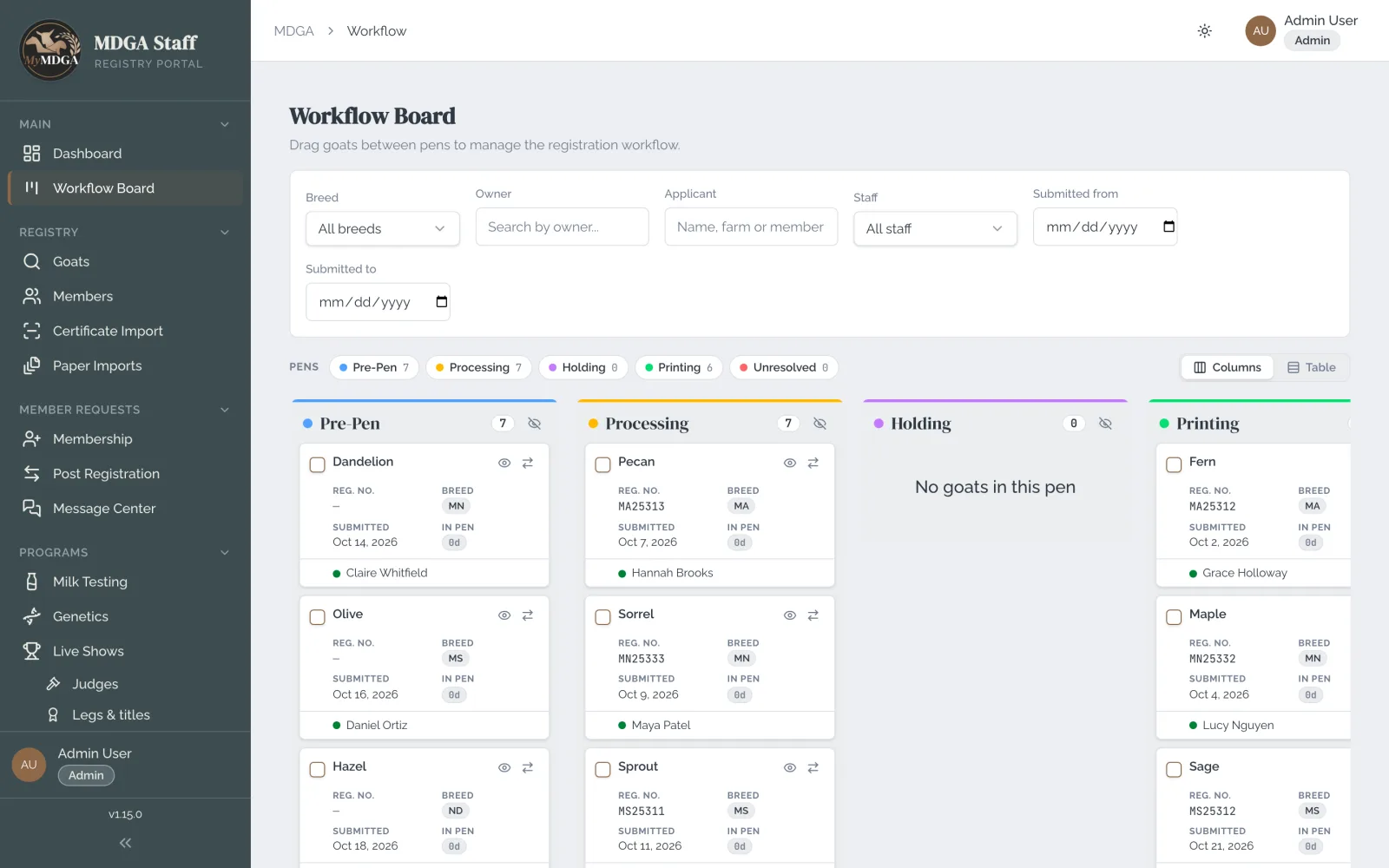 The Workflow Board, one of the screens the staff shaped batch by batch. Every application is a card that moves pen to pen.
From September to launch, MDGA’s staff sent us batches of requests every few days: a list of rule fixes, new screens or edge cases they’d found on the test site. We worked each batch, deployed it to a staging site with real registry data, and the staff tested it the way they’d use it on a Monday morning. Before launch, the platform went through more than 180 versions.
When a screen needed a design decision, we showed the staff two or three mockups side by side and built the one they chose exactly as drawn. The people doing the work picked the layout, not us.
4. Make it safe to change
A registry can’t get a pedigree wrong. Underneath MyMDGA is a regression suite of close to 7,000 automated tests covering registration-number assignment, ownership history, fee rules, pedigree generation and payment handling. A separate staging environment lets the team test new work without touching live data, and every release to live is tagged and reversible.
What We Built
For MDGA staff
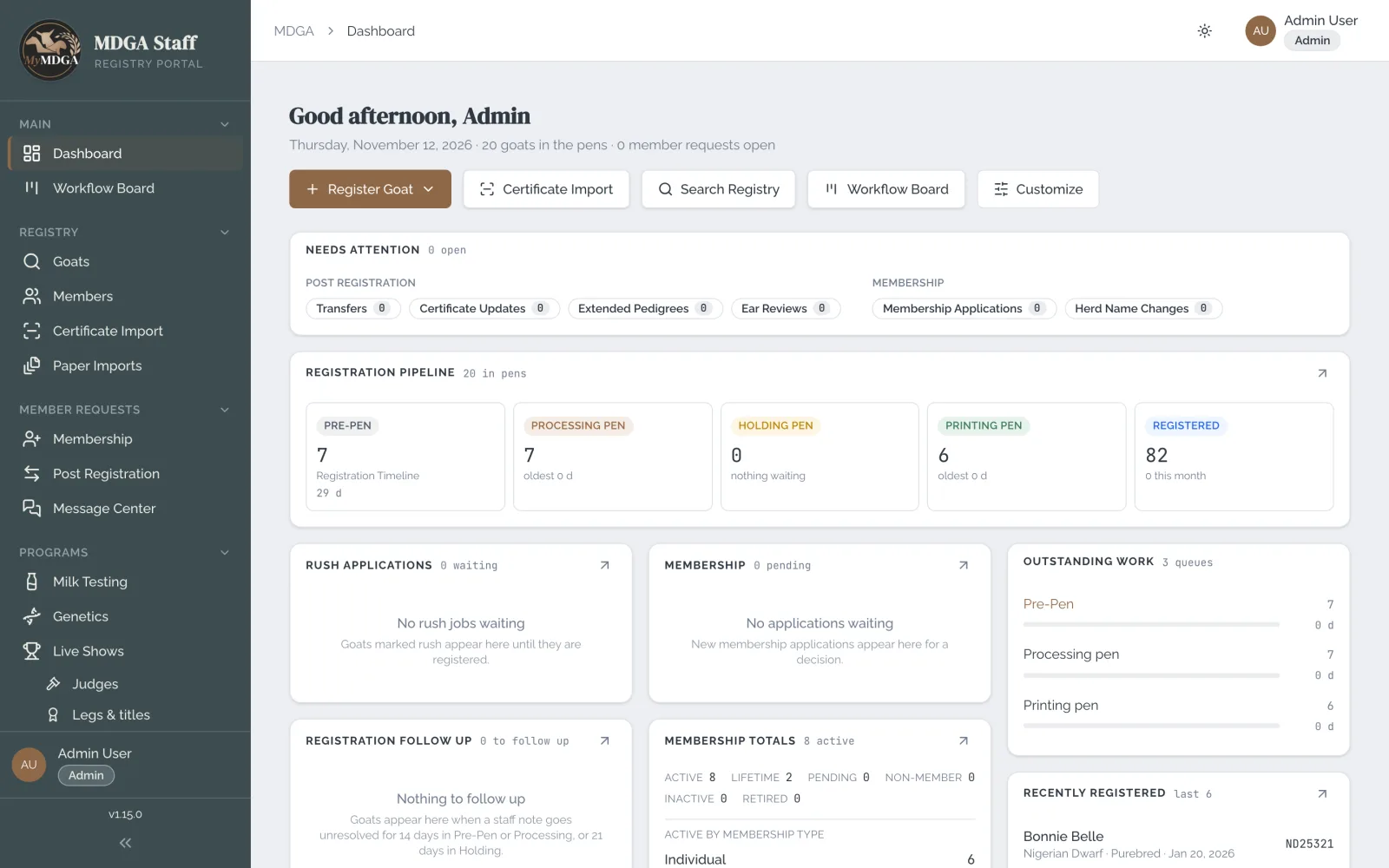
The staff dashboard: what needs attention, how many goats are in each pen, and what was registered most recently.
- A registration workflow from application to processing to approved certificate, with automatic registration numbers by breed, variety and horn status.
- Printed certificates and pedigrees that match MDGA’s official designs, including multi-generation pedigree print options.
- Transfers and ownership history, including co-owners, business owners and multi-owner herds.
- Imports from other registries, so ADGA and CGS certificates come in without re-typing.
- Paper application import, so mailed-in forms enter the same queue as online ones.
- Milk testing and DHIR programs: 305-day and one-day test results, permits and Top Ten lists.
- Genetics and DNA testing, with lab results tied straight to each goat’s record.
- A staff dashboard and reports for registrations, renewals, follow-ups and payments.
- Live Show support, including a Show Desk for show-day staff.
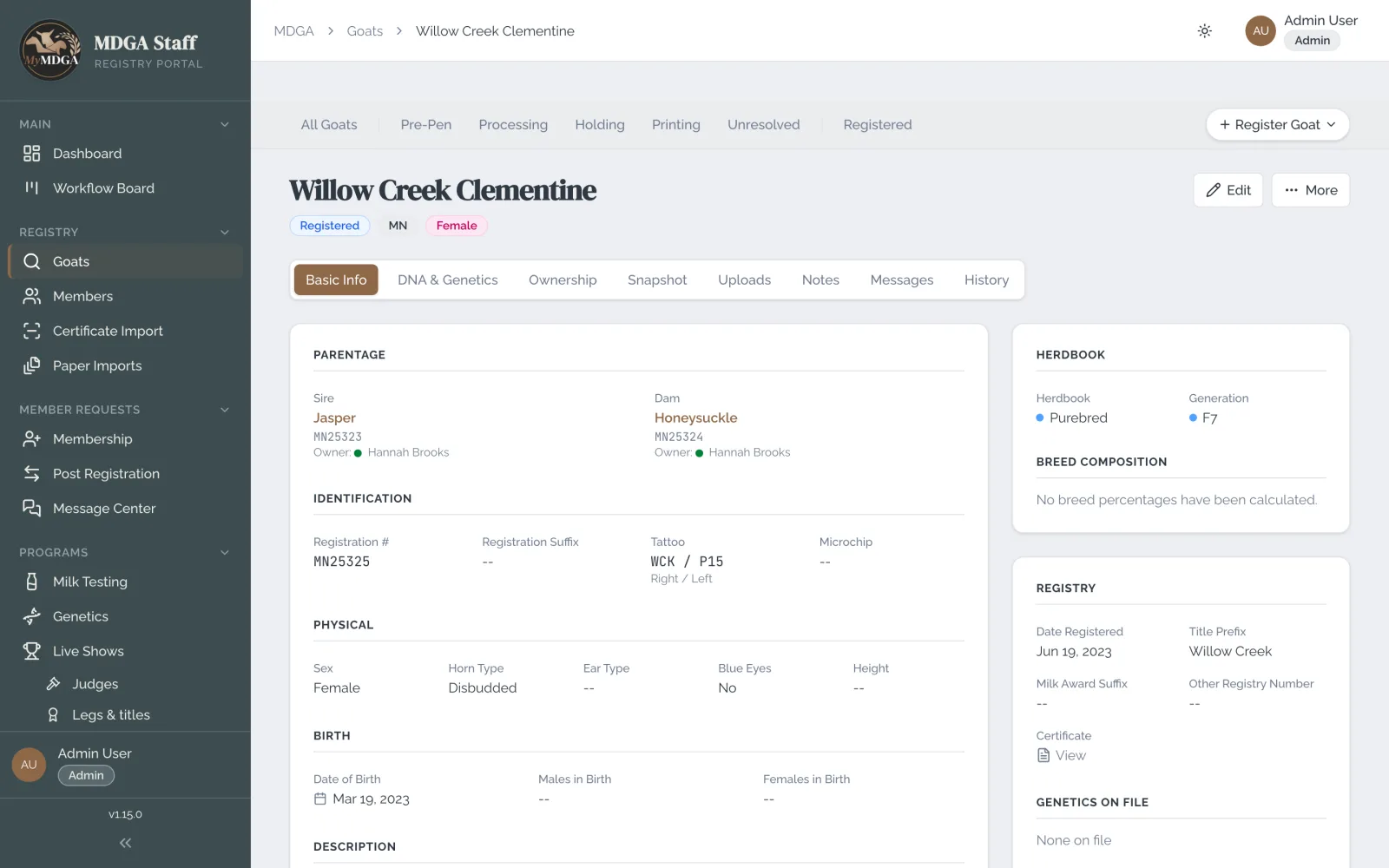 Every goat has one record: parents, registration number, tattoo, herdbook, ownership, DNA and history, each on its own tab.
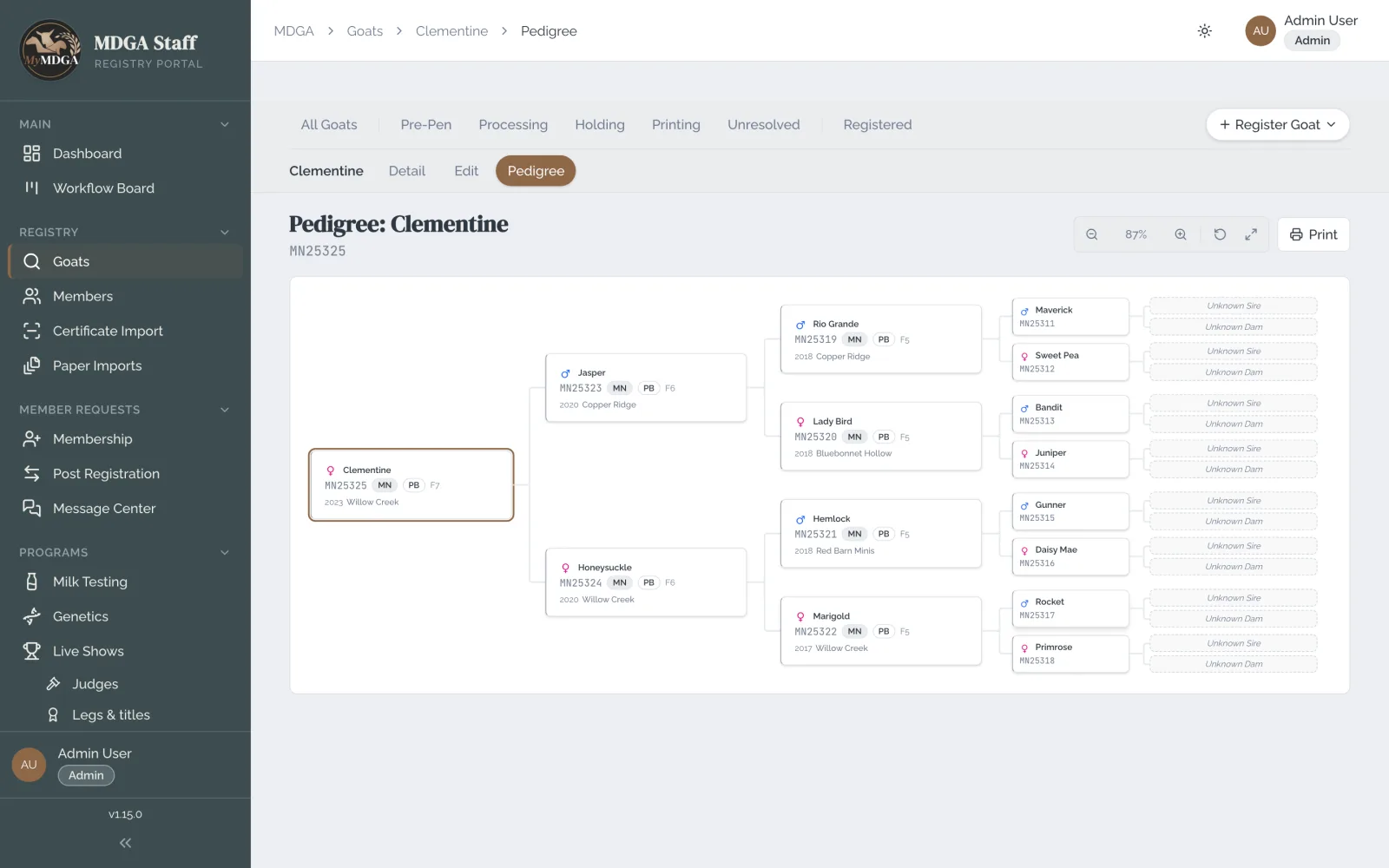 Pedigrees are drawn from the registry itself, so they’re always as current as the data, and print in one click.
For MDGA members
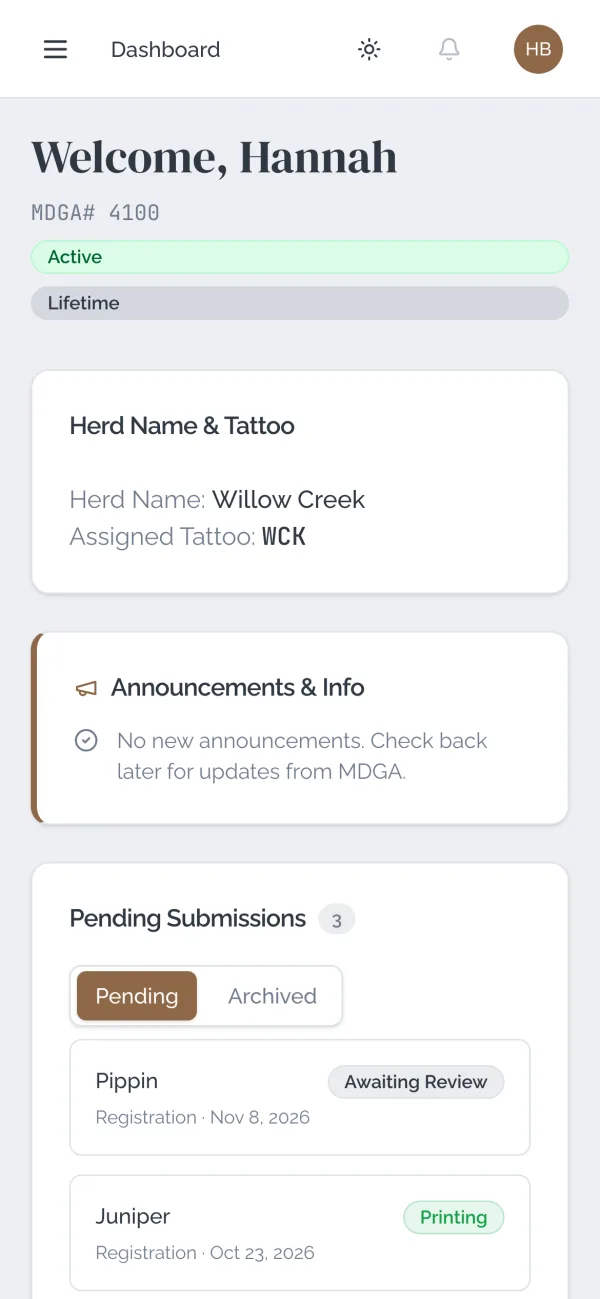
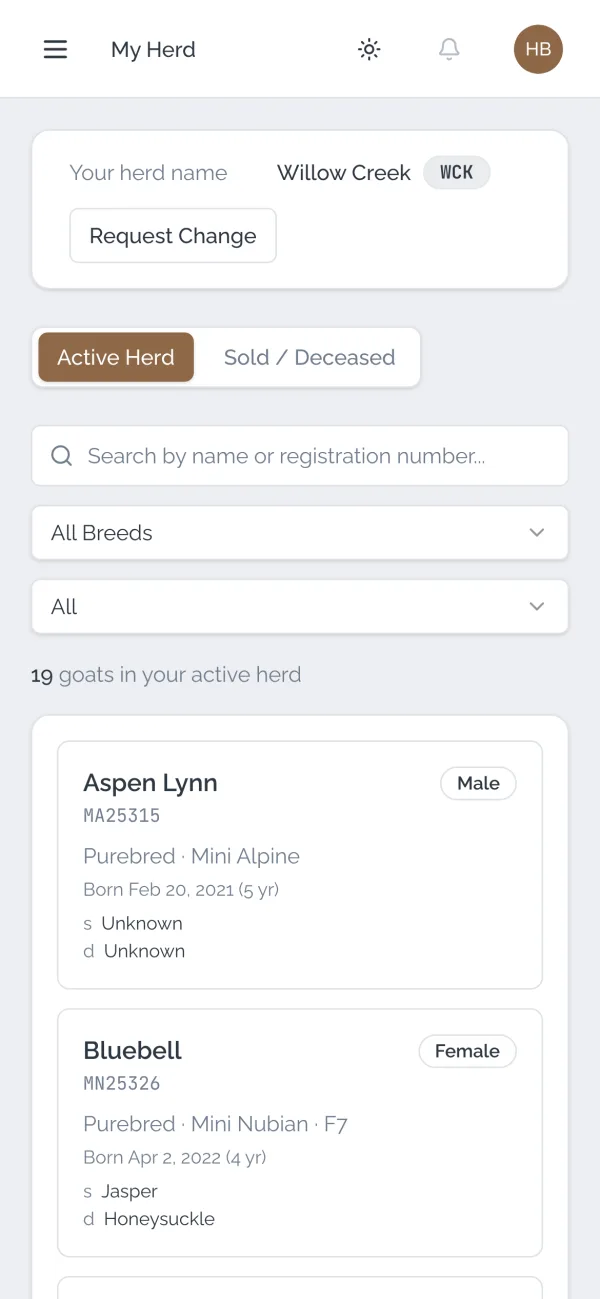
The member portal on a phone: membership status, pending applications and the whole herd, with sire and dam on every goat.
- A self-serve member portal: join, renew, add family members and keep their own profile current.
- Register Goat online, with breeder and ownership history filled in from the goats they already own.
- Online payments by card or PayPal, with receipts, instead of mailing checks.
- Herd records in one place: every goat they own, their milk and genetics results, and the status of every pending application.
- Messages with the registry office inside the portal instead of lost email threads.
- Phone-friendly from the start, with an installable app on the home screen and a guided tour on first sign-in, because most breeders are checking records from the barn, not a desk.
Launch Night
The cutover was planned down to the hour. On October 30, we froze changes, copied the fully tested staging registry to the production server, checked the counts and switched the domain. MyMDGA went live at 6:32 PM Central, with every goat, member and pending application in place.
Since launch we’ve kept to a clear routine: day-to-day work goes to staging for staff testing; batches the MDGA team approves go to live as tagged releases; urgent fixes ship the same day and are merged straight back. In the first two weeks that included new payment reporting, a membership renewals ledger, a staff-only uploads area on member profiles, and phone install support.
Results
| Before | After MyMDGA | |
|---|---|---|
| Where records lived | Legacy database, Airtable, paper, email | One registry platform |
| How members applied | Mail and email | Online, with status they can see |
| How members paid | Checks and manual invoices | Card and PayPal online |
| Outside certificates & lab results | Re-typed by staff | Imported to the goat’s record |
| Goats migrated | — | 73,000+ with full pedigrees |
| Spec to launch | — | About 9 months (Feb–Oct 2026) |
What Made It Work
- The people doing the work tested every change. Staff tried each batch on real data before it went live, so launch day had no surprises.
- Rules were written down. Decades of unwritten registry knowledge are now specs, tests and code that can be checked.
- Data came first. Migrating the real registry early surfaced the hard cases while there was still time to fix them properly.
- Small, frequent releases. More than 180 versions before launch meant every change was small enough to understand and easy to reverse.
Screenshots show MyMDGA with sample data. All farms, members and goats pictured are fictional.
Running an association, registry or membership organization on outdated systems?
Ariel Digital builds custom apps and SaaS platforms for organizations whose records and rules don’t fit off-the-shelf software. Let’s talk about your project →